
+86-15712686880 / +86-576-82424800


Views: 0 Author: Site Editor Publish Time: 2026-02-13 Origin: Site


When an HVAC project falls behind schedule, the reason is rarely the equipment alone—it’s the installation details that quietly add hours, create rework, and increase commissioning risk. In many commercial and residential developments, the ceiling conceal duct type fan coil unit is chosen specifically because it delivers comfortable, quiet air distribution while keeping the mechanical system out of sight. But concealment has a trade-off: installers work in tight ceiling voids, coordinate with multiple trades, and fight for every millimeter of clearance.
That’s why more project teams are paying attention to one small design choice that can have a big impact—round inlets. At first glance, an inlet shape may seem like a minor feature. Yet in real-world installation, round inlets can influence duct routing, connection speed, leakage control, vibration behavior, and even long-term maintenance access. From our experience supporting contractors and system integrators, the question is not “Are round inlets better in every case?” but rather: Do round inlets simplify installation enough to reduce labor cost and improve reliability?
In this article, we’ll answer that question in a practical way. We’ll explain how round inlets affect the installation process of a ceiling conceal duct type fan coil unit, where they provide the strongest advantages, what to watch out for, and how to decide based on your project conditions. Our goal is to help you specify a solution that installs smoothly, performs consistently, and avoids the hidden costs that show up later.
A ceiling conceal duct type fan coil unit is typically installed above a suspended ceiling and connected to a duct network. It uses a fan to pull air through an inlet (return air), passes the air across a heat exchanger coil (chilled water or hot water), and supplies conditioned air through ducts and diffusers. This configuration is widely used in:
Hotels and serviced apartments
Offices and meeting spaces
Hospitals and clinics
Retail and shopping areas
Residential high-rise projects
Compared with exposed units, concealed duct FCUs offer improved aesthetics, flexible air distribution, and the ability to place diffusers where comfort is best. But installation is more complex because it requires precise coordination among:
Mechanical ducting
Electrical wiring and controls
Condensate drainage
Piping (water supply/return)
Ceiling framing and access panels
A small installation complication multiplies quickly when a building has dozens—or hundreds—of fan coil units.
Before we discuss “simplification,” it’s important to define what we mean by inlet design.
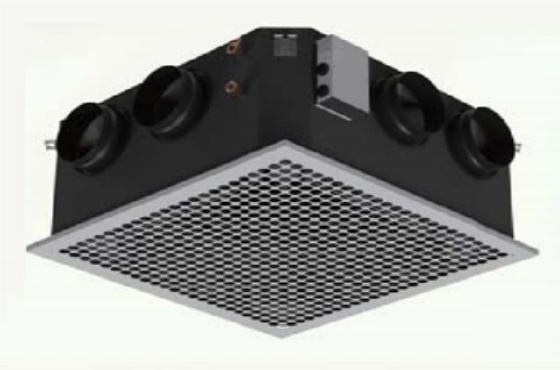
Round inlet: Usually designed to connect directly with round flexible duct or spiral duct using standard clamps, collars, or short connectors.
Rectangular inlet: Often requires a transition piece, flanges, or a fabricated duct connection, especially if the duct route is not perfectly aligned.
Both can work well. The difference is how much on-site adjustment is required to make an airtight, mechanically stable connection.
In many ceiling voids, installers prefer flexible duct because it routes around obstacles easily. A round inlet is naturally compatible with:
Flexible duct
Spiral duct
Standard round collars and clamps
This reduces the need for custom transitions. Less fabrication means fewer measurement errors and fewer return visits to fix fit issues.
Rectangular connections often demand precise alignment: if the duct is slightly off-angle, you may need rework, extra adapters, or additional sealing. A round inlet typically tolerates minor misalignment better, especially when paired with flexible duct. That matters when the unit is installed near beams, lighting trays, sprinklers, or cable trays.
Air leakage at the return side can reduce performance and increase noise. Round connections commonly use uniform clamping pressure around the circumference, making it easier to achieve consistent sealing—especially when installers are working overhead and access is limited.
While not always discussed, the duct connection can transmit vibration. Round flexible duct sections can behave like a buffer between equipment and rigid ducting, helping reduce vibration transfer in certain installations. This can support quieter performance—one of the key reasons developers choose concealed duct FCUs in the first place.
Round connections tend to rely on standard components: clamps, collars, short round connectors, and flexible duct. This can simplify procurement and reduce dependency on custom sheet-metal parts—important when timelines are tight.
Round inlets are particularly useful in these situations:
Projects with high unit counts (time saved per unit becomes significant)
Renovations where ceiling space is irregular and routing is constrained
Sites using flexible duct for return air connections
Fast-track projects where minimizing on-site fabrication is a priority
Contractors with standardized installation crews (repeatable steps improve quality)
To be fair, round inlets don’t automatically solve every installation challenge. You should consider alternatives when:
The return air is designed as a large plenum box that connects more naturally to a rectangular opening
Your duct system is primarily rectangular sheet metal and already standardized around rectangular interfaces
The ceiling void has very limited height, and a round collar adds clearance that conflicts with framing or insulation
The project requires a specific airflow distribution design that favors a rectangular layout
The best approach is to match inlet design to the ducting strategy, not to select based on one feature alone.
Installation Aspect | Round Inlet | Rectangular Inlet |
On-site fabrication need | Usually lower | Often higher (transitions/flanges) |
Connection speed | Faster with standard clamps | Slower if custom duct pieces needed |
Alignment tolerance | Generally better | More sensitive to misalignment |
Sealing consistency | Often easier to standardize | Depends heavily on workmanship |
Fit with flexible duct | Natural match | Possible but may need adapter |
Fit with rectangular duct | Needs transition | Natural match |
Space/clearance impact | Collar may need extra height | Can be flatter in some designs |
From a project manager’s perspective, simplification is not only about saving minutes—it’s about reducing installation risk. Round inlets can contribute to:
If each unit saves even 15–30 minutes across duct connection and sealing, the total savings across dozens of units can be substantial.
Standardized connections reduce variance between installers, which improves overall quality and reduces callbacks.
A cleaner return connection can improve airflow stability and reduce unwanted whistling or vibration-related noise.
When duct connections are consistent, troubleshooting becomes easier and airflow balancing is more predictable.
If your design team is considering round inlets for a ceiling conceal duct type fan coil unit, these tips help maximize the benefit:
Confirm duct type early
Round inlets work best when the return duct plan supports round or flexible routing.
Control duct length and bending
Flexible duct is convenient but excessive length and sharp bends increase pressure loss and noise. Keep bends gentle and lengths reasonable.
Use proper sealing and insulation
Even with round clamps, sealing tape or gasket methods should match your standards. Insulation should be continuous to prevent condensation risk in humid climates.
Plan service access
Concealed systems must be maintainable. Ensure access panels allow filter servicing, motor access, and drainage inspection.
Coordinate with ceiling framing
Round collars can require extra clearance. Confirm coordination drawings early to prevent clashes with framing or lighting.
In many projects, yes—round inlets can simplify ceiling conceal duct type fan coil unit installation, particularly when the return air connection uses flexible ducting or round duct standards. The key advantages are faster connections, reduced fabrication, easier alignment in tight spaces, and more standardized sealing. That said, the best choice still depends on your ducting strategy, ceiling clearance, and service access plan.
At Taizhou MECO Refrigeration Equipment Co.,Ltd., we focus on practical engineering details that help contractors and developers deliver smooth installations and stable long-term performance. If you’re selecting a ceiling conceal duct type fan coil unit for a new build or renovation, our team can share configuration options, inlet design guidance, and selection support based on your site constraints and airflow requirements. If you’d like to learn more about suitable models, installation considerations, or project matching, you’re welcome to contact us and discuss your application.
1) Do round inlets reduce installation time for a ceiling conceal duct type fan coil unit?
Often yes. Round inlets can connect faster with standard clamps and flexible ducts, reducing on-site fabrication and alignment work.
2) Are round inlet connections more airtight than rectangular ones?
They can be, especially when installers achieve uniform clamping and proper sealing. However, airtightness still depends on workmanship and materials.
3) Can a round inlet work with rectangular duct systems?
Yes, but it typically requires a transition piece. If your system is fully rectangular, a rectangular inlet may be simpler overall.
4) Does inlet shape affect noise in concealed duct fan coil units?
Indirectly. Poor connections and high turbulence can increase noise. A well-sealed, smoothly routed inlet connection can support quieter operation.