
+86-15712686880 / +86-576-82424800


Views: 0 Author: Site Editor Publish Time: 2026-06-23 Origin: Site


For commercial builds and major retrofits, selecting the right terminal HVAC equipment directly impacts ceiling clearance, acoustic comfort, and long-term maintenance budgets. Engineers and architects face constant pressure to optimize these overhead spaces. You must balance functional cooling needs against strict interior design goals.
While both systems sit above the occupied space, the choice between a ductless cassette and a ducted concealed unit fundamentally alters installation timelines and architectural design. Making the wrong choice can lead to cramped ceiling plenums, noisy office environments, or frustrating maintenance hurdles. You need a reliable system bridging aesthetics and practicality.
This guide provides an evidence-based, side-by-side evaluation of both configurations. We move past basic definitions to address real-world implementation constraints, financial planning, and project-specific suitability. You will learn exactly how to align your mechanical choices with your structural realities.
Architectural Impact: A ceiling concealed fan coil unit offers maximum aesthetic discretion but demands significant plenum depth and careful ductwork coordination.
Installation & Retrofit: A cassette type fan coil unit simplifies installation and maintenance, making it highly cost-effective for open-plan spaces and retrofits.
Air Distribution: Concealed units allow precise, multi-zone air mapping via ducts, whereas cassettes rely on localized, multi-directional throw (e.g., 4-way distribution).
Decision Driver: The final choice hinges on the trade-off between visual integration (Concealed) and installation/maintenance accessibility (Cassette).
HVAC selection cannot happen in a vacuum. It must align seamlessly alongside reflected ceiling plans, fire suppression layouts, and strict acoustic requirements. Architects design spaces to feel open and inviting. Facility managers, conversely, require systems they can service quickly. This tension drives the entire selection process.
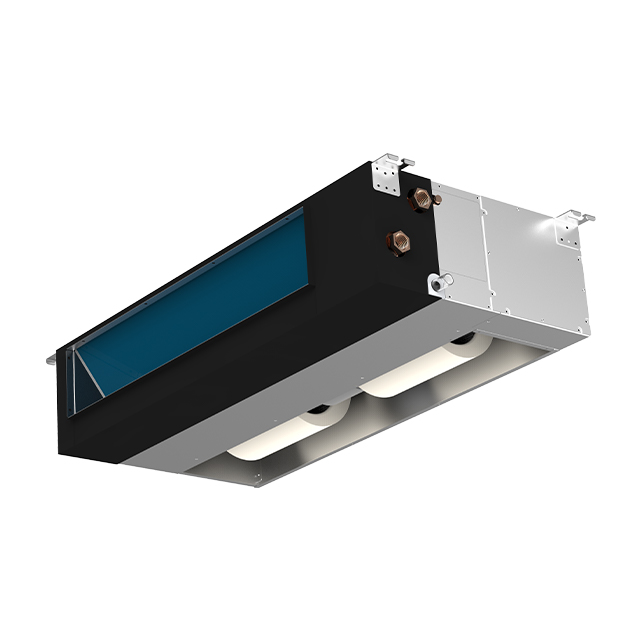
The first baseline is the ceiling concealed ducted FCU. This unit hides entirely inside the ceiling void. It relies on supply and return ducts to deliver air. Occupants only see discrete linear or square diffusers. The mechanical bulk remains entirely out of sight.
The second baseline involves the cassette unit. This self-contained terminal mounts flush against a drop ceiling. It draws warm room air up through the center grille. It then pushes conditioned air out along the perimeter. It requires no extensive external ducting.
The core conflict emerges here. You must balance the architect’s desire for an "invisible" ceiling against the facility manager's need for accessible, low-cost maintenance. Hidden systems look better but cost more to service. Visible systems intrude on design but simplify ongoing operations.
Concealed units excel in high-end design environments. They offer complete visual integration into the space. You only see slim architectural grilles. They also provide superior acoustic isolation. The actual mechanical noise source sits far away from the diffuser. Ductwork naturally attenuates motor sound before it reaches the room.
Flexibility stands out as a primary advantage for the ceiling concealed fan coil unit. You can condition oddly shaped rooms easily. You can even cool multiple small adjacent spaces from a single unit. You achieve this using branched ductwork to push air exactly where needed.
However, implementation risks are substantial. These units require strict minimum ceiling void clearances. You often need 250mm or more depending on static pressure requirements. Furthermore, you face a high reliance on correct duct sizing. Poorly designed ducts cause static pressure drops and inadequate airflow.
Best Practice: Always follow SMACNA guidelines for duct design to minimize air resistance.
Installer Pain Point: You must install dedicated inspection hatches for filter changes.
Common Mistake: Failing to install secondary drain pans. Hidden leaks can cause catastrophic ceiling damage before discovery.
Cassette systems shine during installation and routine operation. They fit neatly into standard commercial grid ceilings. You commonly see them in 600x600mm or 900x900mm tile formats. The 4-way cassette fan coil provides predictable, even, 360-degree air distribution. This multi-directional throw works perfectly in open spaces.
Maintenance staff appreciate these units immensely. You get direct, tool-free access to filters and internal components right from below. Cost efficiency also improves significantly. You eliminate the material and labor costs associated with sheet metal or flexible ducting.
Despite these benefits, cassettes carry distinct implementation risks. They have a high visual footprint. The plastic fascia panel is always visible to occupants. Additionally, most cassettes rely on condensate lift pumps. These pumps introduce mechanical noise and present a distinct point of failure.
Common Mistake: Placing cassettes in highly compartmentalized layouts. You cannot pipe air into a separate room easily. Doing so defeats the purpose of the self-contained cassette.
Best Practice: Schedule routine lift pump testing to prevent unexpected water overflow during peak cooling months.
Financial evaluations must look at both initial capital expenditure (CapEx) and operational expenditure (OpEx). Concealed systems carry a higher initial CapEx. You must pay for the unit, ductwork, grilles, and specialized labor. However, they potentially offer a longer lifespan if protected inside a well-sealed plenum. Cassettes feature a lower initial CapEx. Yet, they require slightly higher maintenance frequency for fascia cleaning and lift pump checks.
Space and clearance create the "Plenum Penalty." We must objectively compare height requirements. Cassettes generally require less continuous void space compared to the sprawling footprint of a ducted system. Ducts must cross over structural beams, demanding deeper overall ceilings.
From a facility management lens, maintenance realities differ wildly. Compare the reality of climbing a simple ladder to unclip a cassette fascia. Contrast this against removing fragile ceiling tiles or unscrewing heavy access panels to reach a hidden filter box. The labor hours add up quickly.
Energy and airflow efficiency also diverge. You must contrast the static pressure losses of a ducted system against the direct-throw efficiency of a cassette. Ducted fans work harder to push air through restrictive passages. Cassettes discharge air directly into the room, reducing fan motor load.
System Comparison Chart
Evaluation Dimension | Concealed Ducted FCU | Cassette FCU |
|---|---|---|
Visual Impact | Hidden (only grilles visible) | High (fascia panel visible) |
Acoustics | Very Quiet (motor hidden away) | Moderate (fan noise in room) |
Maintenance Access | Difficult (requires access hatches) | Easy (direct access from below) |
Installation Cost | High (requires ductwork) | Low (self-contained unit) |
Air Distribution | Highly customizable via ducts | Fixed radial throw (usually 4-way) |
Selecting the right equipment requires matching the system strengths to your specific architectural environment. Different commercial sectors demand different comfort strategies.
When to specify the Concealed Ducted FCU:
Luxury Hospitality: Hotel rooms require pin-drop quiet operation. Aesthetics and acoustics are non-negotiable.
Executive Offices: Partitioned corporate spaces need discrete air delivery without visible ceiling clutter.
High-End Residential: Homeowners often demand invisible climate control.
Custom Ceilings: Spaces utilizing drywall or gypsum ceilings pair beautifully with linear slot diffusers.
When to specify the cassette type fan coil unit:
Open-Plan Commercial Offices: These rooms benefit from the wide, even throw of a cassette.
Retail Showrooms: High-turnover retail environments need easy maintenance access above the sales floor.
IT and Server Rooms: Direct, high-volume sensible cooling works efficiently here.
Retrofit Projects: Preserving existing ceiling structures and minimizing downtime serves as the primary success criterion.
Smart engineers often deploy hybrid approaches. You can use concealed units in boardrooms and lobbies to maximize elegance. You then install cassettes in the open-plan work areas. This strategy optimizes the overall project budget while delivering performance exactly where needed.
Acknowledge Core Trade-Offs: Neither unit is objectively superior. The right choice is a calculated balance of ceiling space, budget constraints, and design intent.
Confirm Architectural Limits: Lock in your ceiling height requirements and verify plenum depths before procuring any units.
Assess Operational Capability: Honestly evaluate your facility team's maintenance capabilities. Choose accessible systems if labor budgets are tight.
Next-Step Action: Consult your HVAC engineer to run static pressure calculations for ducted units. Ask them to perform throw-distance mapping for cassettes. Finalize your bill of materials based on these hard numbers.
A: Concealed units are generally quieter in the occupied space. The mechanical noise from the fan and motor is physically buffered by the ceiling structure. The ductwork itself also absorbs sound before air reaches the room.
A: Yes, but it requires extreme precision. You must cut a perfect opening so the fascia panel overlaps the edges cleanly. However, standard drop-grid ceilings remain the most practical and common use case for cassettes.
A: Cassettes almost always have built-in lift pumps due to their flush-mount design. Concealed units can often rely entirely on gravity drains depending on their placement in the plenum. This eliminates one potential point of mechanical failure.
A: Power consumption is very similar for equivalent cooling capacities. However, ducted units may require slightly more fan motor power to overcome static pressure inside the ducts. Routine maintenance labor costs are typically lower for cassette units.