Specify fan coil units with confidence. Guide to acoustics, EC motors, and drainage to prevent costly HVAC failures and optimize comfort.
Compare fan coil units vs air handling units: a vendor-neutral framework to select the right HVAC system for zoning, IAQ, and cost—avoid over-engineering or inadequate ventilation.
Struggling with HVAC changeover seasons? Our 2-pipe vs 4-pipe fan coil comparison reveals how to balance upfront cost and long-term tenant comfort.
Ceiling concealed vs cassette fan coil units: compare aesthetics, acoustics, & maintenance to select the perfect HVAC for your commercial space.
Cut hotel HVAC noise with data-driven specs, not marketing claims. Learn acoustic metrics and low-noise fan coil selection for silent rooms.
Water leakage from ceiling-mounted HVAC equipment is a building manager's nightmare. A single drip can stain expensive ceiling tiles, damage interior finishes, create slip hazards, and lead to mold growth that affects indoor air quality. For commercial spaces such as hotels, offices, hospitals, and
In a hospital environment, the HVAC system is not merely a matter of occupant comfort—it is a critical component of infection prevention. Nowhere is this more true than in clean rooms, operating theaters, intensive care units (ICUs), isolation wards, and pharmaceutical preparation areas. For these s
Selecting the optimal location for a Floor Standing Concealed Type Fan Coil Unit is one of the most critical decisions in any HVAC system design. The placement of these units directly affects thermal comfort, energy efficiency, equipment longevity, maintenance accessibility, and even property aesthe
How to Clean the Drain Pan of a Concealed Fan Coil Unit?A water stain spreading across a ceiling tile is one of the most dreaded sights for any facility manager or building owner. In hotels, office buildings, hospitals, and residential complexes, water dripping from a Concealed Fan Coil Unit not onl
How to Reduce Vibration Noise in Ducted Fan Coil Units?Excessive vibration noise from a Ducted Fan Coil Units is one of the most frequent complaints in commercial and residential HVAC systems. In hotels, office buildings, hospitals, and apartment complexes, constant rattling, humming, or rumbling fr
Selecting the correct static pressure is one of the most critical—but often misunderstood—steps when designing an HVAC system using a ceiling conceal duct type fan coil unit. In commercial buildings, hotels, hospitals, offices, and residential developments, these units are widely used for their quiet operation, space-saving installation, and flexible air distribution. However, even the most advanced fan coil unit cannot perform as intended if static pressure is improperly selected.
When an HVAC project falls behind schedule, the reason is rarely the equipment alone—it’s the installation details that quietly add hours, create rework, and increase commissioning risk. In many commercial and residential developments, the ceiling conceal duct type fan coil unit is chosen specifically because it delivers comfortable, quiet air distribution while keeping the mechanical system out of sight. But concealment has a trade-off: installers work in tight ceiling voids, coordinate with multiple trades, and fight for every millimeter of clearance.
In modern commercial and industrial HVAC systems, ceiling conceal duct type fan coil units have become a preferred solution for projects that demand quiet operation, flexible air distribution, and clean architectural integration. From hotels and hospitals to office buildings and manufacturing facilities, these systems deliver efficient temperature control while remaining completely hidden above ceilings.
In modern commercial and residential HVAC projects, ceiling conceal duct type fan coil units are widely adopted for their compact structure, quiet operation, and ability to deliver uniform air distribution while remaining visually unobtrusive. However, one technical question frequently arises during system design and installation: when is a drain pump required for a ceiling conceal duct type fan coil unit?
Indoor air quality has become a critical consideration in modern commercial and residential HVAC design. As building owners and project engineers focus more on long-term system reliability, energy efficiency, and occupant comfort, filtration choices inside HVAC equipment are receiving renewed attention. One common question we hear from contractors, developers, and facility managers is whether a G4 filter is truly worth installing in a ceiling conceal duct type fan coil unit.
A cassette-type fan coil unit (FCU) is an essential component of many HVAC systems, offering an efficient way to cool and heat indoor spaces. These units are typically mounted in the ceiling, with the supply air distributed through the four sides of the unit, making them ideal for areas with limited space or where a discreet solution is required. Like any HVAC equipment, proper maintenance is essential to ensure the cassette fan coil unit operates at peak performance throughout its lifespan. Regular maintenance not only helps optimize performance but also extends the unit’s lifespan, improves energy efficiency, and prevents costly breakdowns.
Indoor air quality (IAQ) has become a critical concern for many homeowners and business owners, as the health of the people inside these spaces is closely linked to the quality of the air they breathe. Poor IAQ can lead to various health issues, including allergies, asthma, and respiratory problems. In response, many have turned to advanced HVAC systems to help maintain a healthier indoor environment. One such solution is the Ducted Fan Coil Unit (FCU), which plays a significant role in improving indoor air quality.
In today’s commercial environment, maintaining a comfortable indoor climate is essential for productivity, employee well-being, and customer satisfaction. With businesses becoming more energy-conscious and looking for cost-effective yet efficient HVAC solutions, the ducted fan coil unit (FCU) has emerged as a popular choice for commercial spaces. This article explores the reasons why a ducted fan coil unit is an excellent investment for your business.
important decisions you’ll make is selecting between ducted and non-ducted fan coil units (FCUs). Both systems offer unique advantages depending on the size, layout, and specific needs of your space. In this guide, we’ll explore the key differences between ducted and non-ducted fan coil units, the benefits of each, and how to choose the right system for your property.
When it comes to creating a comfortable and efficient indoor environment, selecting the right heating and cooling systems is paramount. One such essential system is the ducted fan coil unit. These units are crucial components in heating, ventilation, and air conditioning (HVAC) systems, offering energy-efficient solutions for both commercial and residential buildings. However, choosing the right ducted fan coil unit for your building can be a daunting task, especially considering the variety of models and features available on the market.
| Availability: | |
|---|---|
| Quantity: | |
DC-MFP-170MAW
MECO
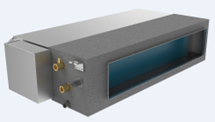
The DC-MFP-170MAW is a horizontal ducted fan coil unit designed for medium static pressure applications. It delivers 1700 m³/h of airflow at 75 Pa static pressure, supporting ducted air distribution in medium-sized commercial spaces. The unit operates with a 0-10V DC motor and connects to chilled / hot water systems via ZG3/4" water ports.
Parameter | Value |
|---|---|
Model | DC-MFP-170MAW |
Air Volume | 1700 m³/h |
Static Pressure | 75 Pa |
Cooling Capacity | 10200 W |
Heating Capacity | 16400 W |
Noise Level | 54 dB |
Power Input | 200 W |
Water Pressure Drop | 32 kPa |
Water Tube Connection (Inlet) | ZG3/4" |
Water Tube Connection (Outlet) | ZG3/4" |
| |
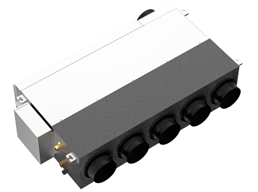
The unit casing is fabricated from aluminized zinc coated steel sheet, which provides corrosion resistance for ceiling-mounted installations. The enclosure is designed for horizontal duct mounting and fits within standard suspended ceiling cavities.
The unit is equipped with a large-diameter centrifugal fan that delivers the rated air volume while maintaining a 54 dB noise level at rated operation. The fan is driven by a 0-10V variable speed DC motor. Compared with equivalent AC motor configurations, the DC motor reduces energy consumption by over 40 percent under the same airflow output.
Fresh air can be introduced from an external source through a dedicated connection, allowing the unit to work alongside dedicated outdoor air systems. The standard unit ships with square duct interfaces; circular duct interfaces are available as a configurable option. Static pressure can be selected within the 30-75 Pa range to match specific duct length requirements.
This medium static pressure fan coil unit suits commercial buildings including offices, hotels, hospitals, retail spaces, and education facilities. It integrates with central chilled water HVAC systems and distributes conditioned air through ductwork to multiple rooms or zones.
The 30-75 Pa static pressure range supports medium-length duct runs, making the unit suitable for projects where low static pressure units cannot deliver sufficient throw distance and high static pressure units would exceed project requirements. The horizontal duct configuration allows installation above suspended ceilings, keeping the unit concealed from occupied spaces.
For business buyers specifying HVAC equipment for new construction or retrofit projects, the unit offers compatibility with standard hydronic systems and supports both two-pipe and four-pipe configurations depending on project requirements.
The unit is designed for ceiling-concealed installation. Its horizontal form factor fits within standard ceiling plenum spaces. Water inlet and outlet connections are sized ZG3/4", matching common hydronic system piping specifications.
Routine maintenance involves filter inspection and replacement, coil cleaning, and fan assembly inspection. Access panels and service-side connections are positioned to support maintenance from below the ceiling. The DC motor operates with brushless technology, reducing the frequency of motor service compared with brushed alternatives.
Medium static pressure units (30-75 Pa) deliver higher airflow resistance capability than low static pressure units, enabling longer duct runs and more air distribution branches. They operate at lower pressure than high static pressure units, which are intended for extensive duct networks.
Yes, the unit supports fresh air intake from an outside source. A dedicated fresh air connection allows integration with dedicated outdoor air systems (DOAS) for ventilation air supply.
Under equivalent airflow output, the DC motor configuration reduces power consumption by over 40 percent relative to a comparable AC motor, according to internal test data. This translates to lower ongoing operational electricity cost.
The unit ships with standard square duct interfaces. Circular duct interfaces are available as an optional configuration for projects using round ductwork.

